
EFE 2026 Energy Fuels Environment
publications
Authors of accepted papers presented during EFE 2026 will have the opportunity to publish their research in selected scientific journals and conference publications, subject to the scope of the journal, successful peer review, and fulfillment of the editorial requirements.
The publication opportunities available for EFE 2026 include (click link to slide down to the description):
- International Journal of Minerals, Metallurgy and Materials (Springer Nature)
- Applied Mathematical Modelling – Special Issue: Mathematical Modeling of Disasters: New Trends and Perspectives
- Energies – Special Issue: Combustion Optimization and Emission Reduction in Energy Systems
- Molecules – Special Issue: Advanced Structured Catalysts for Sustainable Chemical Transformations
- Geology, Geophysics and Environment
- Sustainability – Special Issue: Energy Fuels Environment – Linking Energy, Fuels and the Environment for a Sustainable Transition
- Przemysł Chemiczny
- Archives of Thermodynamics
Detailed information for each publication opportunity, including the journal scope, submission procedure, editorial requirements, important deadlines, and submission links, is provided in the individual sections below.
The deadline for submitting papers to the Scientific Committee of the conference is November 20, 2026 via conference email. The scientific committee selects articles for publication.
Note: All submitted papers will undergo the standard peer-review process. Please note that the standard Article Processing Charges (APC) of the journal apply to all submissions.
Call for Papers: Sustainability


Special Issue:
Energy Fuels Environment – Linking Energy, Fuels and the Environment for a Sustainable Transition
Link to special issue: https://www.mdpi.com/journal/sustainability/special_issues/Q1OW597W4Y
Deadline for manuscript submissions: 31 July 2027
Dear Colleagues,
This Special Issue aims to address interdisciplinary challenges related to energy transition, fuel technologies, and environmental protection, with particular emphasis on sustainability and the development of low-emission energy systems. It is dedicated to selected contributions from the International Conference on Energy Fuels Environment EFE 2026 and welcomes high-quality original research and review papers that advance knowledge at the interface of energy, fuels, and the environment. The Special Issue seeks to present recent scientific, technological, and practical developments supporting efficient, low-emission, and environmentally responsible energy systems. Contributions may address both fundamental and applied research, including innovative energy technologies, future fuels, hydrogen, emission and pollution control, environmental monitoring, resource and energy recovery, circular economy solutions, energy policy and economics, and advanced materials for energy conversion and storage. By integrating diverse research perspectives, this Special Issue aims to facilitate knowledge exchange among academia, industry, public administration, and socio-economic stakeholders and to promote solutions aligned with sustainable development and circular economy principles. Topics include, but are not limited to:
- Low-emission power and heat technologies
- Renewable energy technologies, energy storage, and energy harvesting
- Future fuels, biofuels, waste-derived fuels, and CO₂-based fuel production
- Hydrogen production, storage, and applications
- Combustion processes, catalysis, and industrial decarbonization
- Emission reduction, pollution control, and environmental monitoring
- Climate change, global warming, and environmental protection
- Circular economy, resource recovery, and energy recovery
- Energy efficiency in buildings, district heating, and industrial systems
- Nuclear energy technologies and reactor safety
- Ecological transport and low-emission mobility
- Energy policy, economics, modelling, and decision support
- Advanced materials for energy conversion and storage.
Prof. Dr. Krzysztof Sornek
Prof. Dr. Katarzyna Styszko
Prof. Dr. Artur Wyrwa
Guest Editors
- Editors
- Special Issue Information
- Keywords
- Benefits of Publishing in a Special Issue
- Published Papers
A special issue of Sustainability (ISSN 2071-1050). This special issue belongs to the section “Energy Sustainability“.
Note: All submitted papers will undergo the standard peer-review process. Please note that the standard Article Processing Charges (APC) of the journal apply to all submissions.
High-quality papers presented at the conference are invited for submission to the :
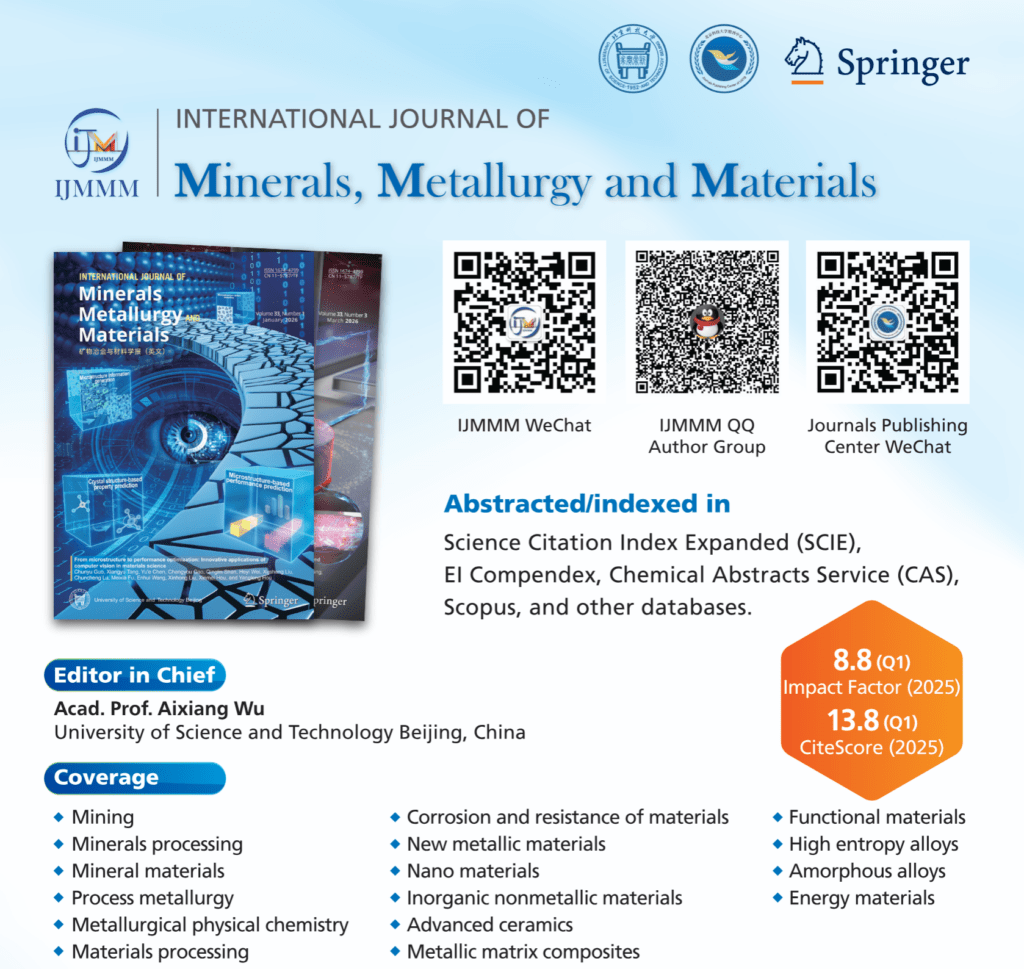
International Journal of Minerals, Metallurgy and Materials
(Springer Nature, Q1, Impact Factor: 8.8)
Under the Springer Open Access (OA) publishing agreement, authors affiliated with eligible institutions may publish their articles in OA mode without additional fees. For further details, please refer to the AGH University Main Library.
The online submission system for this journal is available at:
https://mc03.manuscriptcentral.com/ijom
Please note that the following steps will apply when submitting to this journal:
Manuscripts must undergo a preliminary review by the Conference Academic Committee.
To ensure proper identification of conference submissions, authors must select “EFE2026” at the “Type” stage during the submission process.
All submitted manuscripts will be rigorously evaluated through a double-blind peer-review process within the journal’s online submission system.
About the Journal
The International Journal of Minerals, Metallurgy and Materials is indexed in major databases including Science Citation Index Expanded (SCIE), EI, Scopus, INSPEC, and Google Scholar. The journal has a 2024 ISI Impact Factor of 7.2 (Q1) and a CiteScore of 11.4 (Q1). According to the latest data (as of April 24, 2026), its real-time Impact Factor and CiteScore have increased to 8.8 and 13.7, respectively.
The journal operates a rigorous and efficient peer-review process, with an average of 31 days from submission to first decision and 56 days from submission to acceptance.
IJMMM is a monthly journal sponsored by the University of Science and Technology Beijing. It publishes peer-reviewed original research articles and invited reviews covering all aspects of minerals processing, physical metallurgy, process metallurgy, and materials science. The journal emphasizes the relationships among processing, structure, and properties of minerals, metals, and materials. Key topics include nanomaterials, advanced metallic materials, inorganic non-metallic materials, energy materials, advanced ceramics, functional materials, and metal matrix composites.
For more information, please visit:
https://www.springer.com/journal/12613
Applied Mathematical Modelling
Mathematical Modeling of Disasters: New Trends and Perspectives
Submission deadline: 01 August 2026
The aim of the proposed special model is to collect papers focused on mathematical modeling and resulting computer simulations of important challenging natural phenomena often related to natural disasters.
Examples of possible applications include mathematical modeling of tsunami phenomena on a globe model based on shallow water equations, modeling of thermal inversion and pollution propagation in urban areas based on advection-diffusion-reaction equations, modeling avalanches in mountainous areas, modeling wildfires based on a nonlinear models with diffusion, advection and radiation terms, modeling earthquakes based on nonlinear wave equations, modeling atmospheric phenomena, including climate change using Navier-Stokes-Boussinesq equations, among others.
Mathematical modeling and the resulting computer simulations can have wide applications to challenging problems important to humanity.
Guest editors:
Prof. Maciej Paszyński
Faculty of Computer Science, AGH University of Krakow, Poland
Email: paszynsk@agh.edu.pl
Prof. Jacek Leszczyński
Faculty of Power and Energy, AGH University of Krakow, Poland
Email: jale@agh.edu.pl
Special issue information:
This special issue focuses on the development and application of advanced mathematical modeling and numerical methods for simulating complex natural and environmental phenomena. Contributions that explore finite element methods, physics-informed neural networks (PINNs), and other computational approaches for solving hyperbolic and parabolic partial differential equations (PDEs), particularly in the context of non-linear problems, are highly encouraged.
Topics of interest include, but are not limited to, tsunami, wildfire, avalanche, and pollution modeling, as well as the simulation of atmospheric phenomena. The issue aims to bridge theoretical advances in mathematical modeling with practical, high-impact applications in natural hazard prediction, environmental assessment, and scientific computing.
Manuscript submission information:
The journal’s submission platform (Submit your manuscript | Applied Mathematical Modelling) will be open for submissions to this Special Issue from Mar 01, 2026. Please refer to the Guide for Authors to prepare your manuscript and select the article type of “VSI:APM_Mathematical Modeling of Disasters” when submitting your manuscript online. Both the Guide for Authors and the submission portal could be found on the Journal Homepage: Applied Mathematical Modelling | Journal | ScienceDirect.com by Elsevier.
The impact of SI contributions should be clearly demonstrated in the context of the theme of the special issue. Papers that do not directly address this theme are considered out of scope and are subject to immediate rejection.
Timeline: Submission Open Date: Mar 01, 2026
Final Date for Submission: Aug 01, 2026
Keywords:Mathematical Modelling, Experiments and Simulations for 1.Environmental Disasters:Tsunami, Volcanos, Earthquakes, Wildfires, Floods, Avalanches. 2. Technological Disasters: Pollution, Plastic Pollution. 3. Numerical Methods for PDEs and PINNs


Special Issue Title: Combustion Optimization and Emission Reduction in Energy Systems
Dear Colleagues,
Combustion processes remain fundamental to modern energy systems and industrial operations despite the ongoing transition toward low-carbon technologies. They continue to play a crucial role in power generation, industrial furnaces, transportation systems, metallurgical processes, waste-to-energy plants, and distributed heating applications. However, conventional combustion technologies are still associated with significant emissions of carbon dioxide, nitrogen oxides, sulfur oxides, particulate matter, and other harmful pollutants. Increasing environmental regulations, rising energy efficiency requirements, and global decarbonization goals have accelerated research efforts toward cleaner combustion technologies, alternative fuels, advanced numerical modeling, and emission mitigation strategies. At the same time, the growing integration of hydrogen, ammonia, biomass-derived fuels, synthetic fuels, and carbon capture technologies creates new scientific and engineering challenges related to combustion stability, efficiency, pollutant formation, and operational safety.
This Special Issue aims to present and disseminate the most recent advances related to combustion optimization, emission reduction, alternative fuels, numerical modeling, experimental diagnostics, and sustainable thermal energy systems.
Topics of interest for publication include, but are not limited to:
- Optimization of combustion processes in boilers, furnaces, gas turbines, and power plants
- Reduction of NOx, SOx, CO, CO₂, particulate matter, and unburned hydrocarbon emissions
- Hydrogen combustion technologies
- Ammonia combustion systems
- Biomass combustion and waste-derived fuels
- Syngas and alternative gaseous fuels
- Oxy-fuel combustion
- Carbon capture integration with combustion systems
- Artificial intelligence and machine learning in combustion optimization
- Waste heat recovery systems
- Decarbonization of conventional thermal energy systems
- Hybrid energy systems involving combustion technologies
- Renewable fuel integration into existing combustion infrastructure
Guest Editor: Dr hab. Ing. Rafał Buczyński, prof AGH
Note: All submitted papers will undergo the standard peer-review process. Please note that the standard Article Processing Charges (APC) of the journal apply to all submissions.


Special Issue Title: Advanced Structured Catalysts for Sustainable Chemical Transformations
Dear Colleagues,
The transition toward sustainable chemical transformations requires catalytic systems that combine high activity and selectivity, long-term stability, and process scalability. In this context, advanced structured catalysts, including hierarchically porous materials, nanostructured metal oxides, coated supports, and shaped catalysts, such as pellets and monoliths have been intensively studied. Over the years, application of these materials has resulted in the development of green chemical processes.
This Special Issue, “Advanced Structured Catalysts for Sustainable Chemical Transformations”, is dedicated to recent progress in the design, synthesis, characterization, and application of structured catalytic materials for environmentally responsible chemistry. Therefore, contributions addressing structure–property–performance relationships, the relationships between physicochemical features and catalytic performance, innovative fabrication and shaping strategies, and the integration of catalysts into efficient reactor architectures are particularly encouraged. Relevant applications include biomass conversion, CO2 valorization, selective oxidation and hydrogenation reactions, as well as photo- and electrocatalytic processes. By bringing together original research articles and authoritative reviews, this Special Issue aims to highlight how rational catalyst design can bridge the gap between fundamental catalysis and practical, sustainable chemical technologies.
Guest Editor: Dr. Bogdan Samojeden
Guest Editor Assistant: Dr. Agnieszka Szymaszek-Wawryca
Note: All submitted papers will undergo the standard peer-review process. Please note that the standard Article Processing Charges (APC) of the journal apply to all submissions.

https://journals.agh.edu.pl/geol/about
In cooperation with the Editorial Board of Geology, Geophysics and Environment, we highly encourage all participants to submit academic manuscripts detailing the research findings presented during our scientific sessions.
This is an excellent opportunity to publish your work in a fully peer-reviewed, open-access journal, ensuring high visibility and academic impact for your research.
- Online Submission Portal: https://journals.agh.edu.pl/geol/about/submissions
- Author Guidelines & Formatting: https://journals.agh.edu.pl/geol/authorguidelines
Note: All submitted papers will undergo the standard peer-review process. Accepted articles will be published in the upcoming regular issues of the journal.
Przemysl Chemiczny is the oldest Polish magazine, leading and well-recognized in the industry. Its first issue was published in 1917. Przemysl Chemiczny is an open-access journal.
The journal’s scope:
- Development, economics, and organization of the chemical industry,
- Chemicalization of the national economy,
- Feedstock for the chemical industry,
- Waste utilization,
- organic and inorganic chemistry,
- Plastics processing,
- Pharmaceutical technology,
- Catalysis,
- Sorption,
- Flotation,
- Electrochemistry,
- Equipment,
- Chemical engineering,
- Environmental Protection in the Chemical Industry.
Readers:
Engineering staff and managers at industrial plants; research, engineering, and technical staff at scientific research institutes, industrial research centers, and design offices; and faculty and students in the chemistry departments of universities.
Offer for EFE2026 participants:
A 15% discount is available to EFE2026 participants. To qualify for the discount, the article must be submitted to the Editorial Board by January, 31 2027, and participation must be confirmed by the EFE2026 organizer. Articles should be prepared in accordance with the journal’s requirements. Articles are published only in Polish.
The articles are expected to be published in the first quarter of 2027.
Archives of Thermodynamics
Authors participating in the conference are invited to submit their original research and review articles to the Archives of Thermodynamics (ISSN: 1231-0956 print / 2083-6023 online).
About the Journal Published quarterly, the journal provides a global forum for scientists and engineers to disseminate knowledge in the fields of thermal sciences, mechanical, and power engineering. All articles undergo a rigorous double-blind peer-review process by independent experts.
Aims & Scope The journal’s scope aligns perfectly with the core topics of the conference, welcoming papers on:
- Energy transition, renewable energy sources, and hydrogen energy
- Thermal energy conversion, energy storage, and efficiency
- Secondary fuels, fuel conversion, combustion, and emissions
- Thermal incineration of wastes and waste heat recovery
- Thermodynamic analysis, heat transfer, and fluid flow
Key Benefits for Authors:
- Indexing: Listed in the Web of Science (Emerging Sources Citation Index) and features an Impact Factor.
- Fully Open Access: All content is freely available under the CC BY-NC-ND 4.0 license.
- No Publication Fees: There are zero charges for open-access publication, thanks to funding from the Polish Academy of Sciences (Committee on Thermodynamics and Combustion & Institute of Fluid-Flow Machinery).
More Information & Submission: Please visit the journal’s platform: https://journals.pan.pl/dlibra/journal/97811